


In recent years, the sheet metal fabrication industry has undergone a radical transformation. Press automation systems have evolved from a strenuous and dangerous manual task into a highly automated, intelligent, and integrated system. But what is a press automation system? And why has it become so crucial to industrial competitiveness?
In this comprehensive guide, we explore the technologies, processes, and strategies that define modern press tending in 2026, analyzing how companies can derive maximum value from these systems.

What are press automation systems and why does it matter
When we talk about “feeding,” we are not referring to the legal meaning (which is different from a civil servitude). In an industrial context, machine handling,and specifically press automation systems, refer to the set of systems and devices that feed, position, and manage material (sheet metal, coils, strips) within an automated processing line.
An industrial press applies a controlled and precise force to the material for stamping, cutting, bending, and forming sheet metal, assembling components, and punching. Without an efficient press automation systems, even the best press on the market operates at a fraction of its production capacity.
The transition from manual to automated systems has been a game-changer for numerous industries. In 2010, a press operator had to manually position each part, wait for the press cycle to complete, remove the finished part, and perform quality checks. Today, a press operator supervises automated processes, monitors smart dashboards, and intervenes only in the event of exceptional problems.
Elmea has driven this change: in the 1990s, there were 3–4 operators per line. Today, with robotic press tending systems, one operator manages 4–5 lines simultaneously.
The technologies driving modern automation
Modern press automation systems automation is based on three technological pillars:
- Intelligent control
- Advanced robotics
- Systems integration

Programmable Logic Controllers (PLCs) are the brain of any automated production line. By 2026, PLCs will no longer operate in isolation but as nodes in a distributed network. They will offer edge computing for real-time, latency-free decision-making; predictive maintenance algorithms that forecast failures 48–72 hours in advance; local machine learning that optimizes parameters based on previous cycles; and secure communication using industrial protocols hardened against cyberattacks. Modern Siemens S7-1500, Beckhoff, or Rockwell PLCs achieve processing speeds of up to 10 ns and memory capacities of up to 10 GB for complex programs, while maintaining native SIL 3 certification.
Human-machine interfaces (HMIs) in 2026 are no longer just touchscreens. They are cognitive dashboards that display KPIs in real time, send predictive alerts to operators’ smartphones, enable remote adjustments via remote assistance, and log anomalies for offline analysis. A modern HMI displays not only instantaneous speed but also optimization recommendations.
Robotics has revolutionized machine automation:
- Collaborative robots (Cobots) with payloads ranging from 3 to 20 kg operate safely side by side with operators for alimentation and palletizing
- Industrial articulated robots handle payloads of 50 to 500 kg for medium- to large-scale production lines
- SCARA robots specialized for rapid assembly perform up to 100 cycles per minute
Each type integrates differently: cobots are best suited for shared workspaces, articulated robots offer extreme speed and precision, while SCARA robots optimize the footprint for compact production lines.
True integration takes place at the software level. Simply installing a robot is not enough: the system requires mechanical synchronization with position sensors on straightening presses synchronized to ±0.5 mm, real-time robot-press communication (under 100 ms), and dynamic speed compensation. The middleware translates PLC signals into robot commands, automatically handles exceptions, and activates degraded fallback modes if a component fails.
An integrated press serving line for automotive stamping combines a synchronized motorized straightener, a robot that picks up parts at variable speeds, a variable-cycle press, and a vision system for automatic QC. The result: 450 parts per hour with ±0.1 mm precision, compared to 200 parts per hour at ±0.5 mm for the manual version.

How modern manufacturing processes work
When sheet metal arrives in coils, the first step is cutting. Modern systems no longer use mechanical shears but rather 3D laser cutting lines that reach speeds of up to 15 m/min with an accuracy of ±0.3 mm and incorporate feedback sensors for real-time correction. The system automatically recognizes the material (steel, aluminum, copper) and adjusts the laser parameters, optimizing nesting to reduce scrap by 15–20%.
Bending is the most complex stage. Servo-controlled hydraulic presses offer force control to within ±5% compared to ±20% for mechanical presses, variable bending speeds that accelerate under no-load conditions and decelerate under load, and rapid profile storage with format changeover in 30 seconds. Positioning systems include:
- Pneumatic grippers with grip feedback
- Rotary tables for multi-angle positioning
- Machine vision that verifies the part’s geometry before each cycle
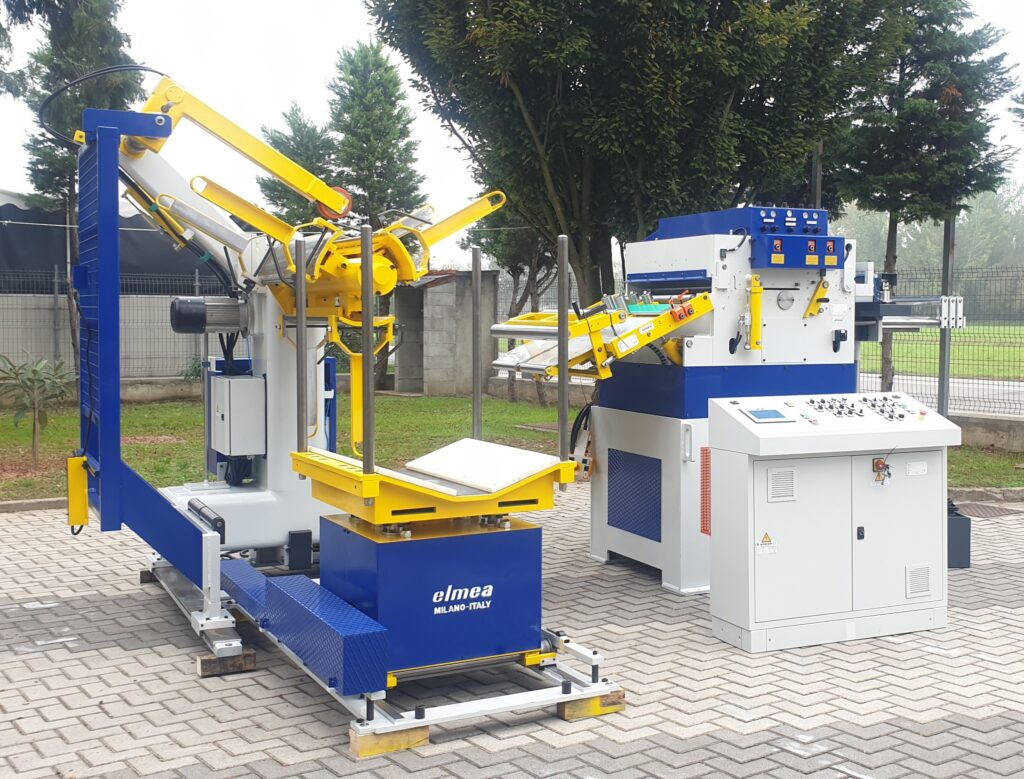
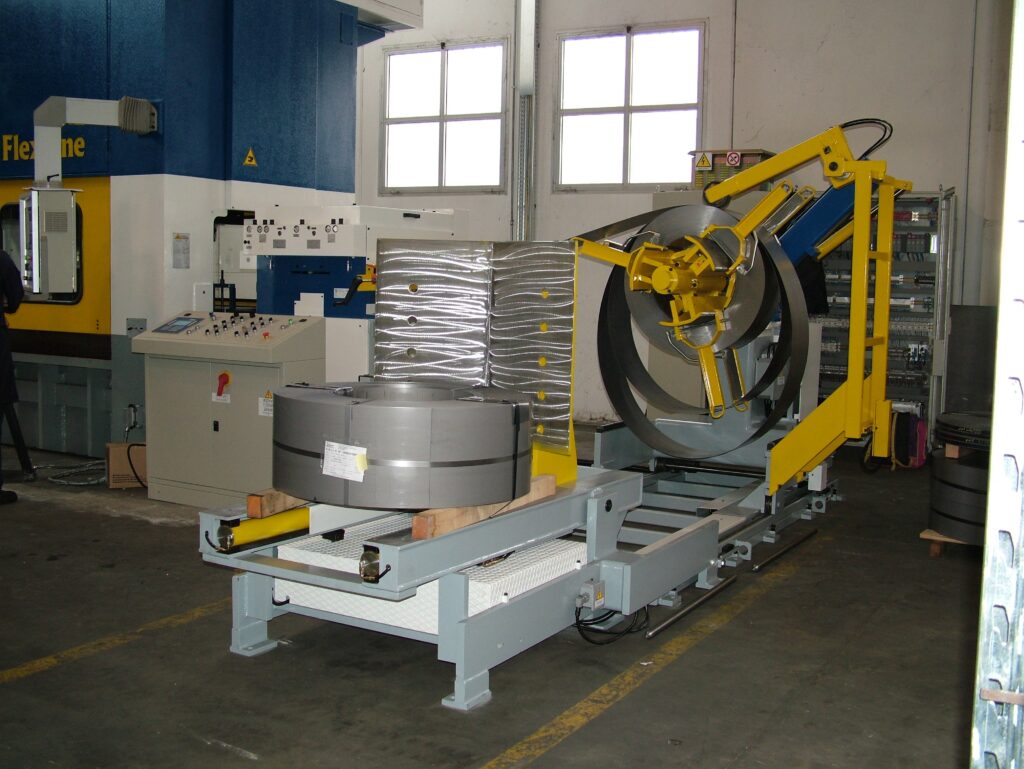
In specific applications, such as handling rolls of mesh with motorized winders and unwinders, the systems become even more sophisticated to ensure a uniform feed.
Robotic assembly and welding are often the most critical stages.
Modern 6-axis robots perform resistance welding with a repeatability of ±0.2 mm, incorporate force sensors to detect contact anomalies, and communicate the number of welds performed per part to the MES system. The assembly process utilizes automatic picking from shelves via 3D vision, precise component positioning, and in-process quality control via an AI camera.
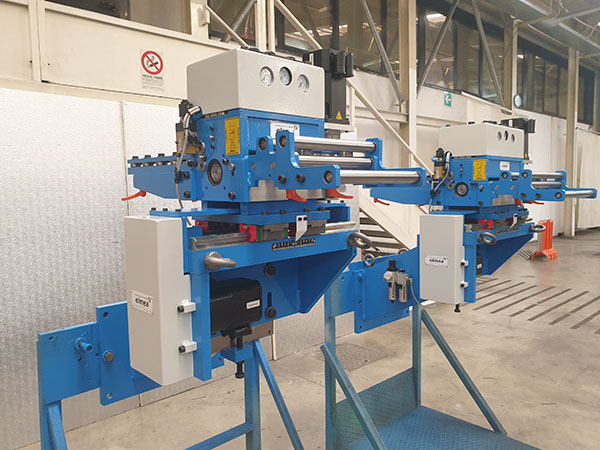
Electronic feeders, particularly systems such as the MA ZIG-ZAG feeder, also play a crucial role in reducing material waste and optimizing sheet metal utilization during controlled automatatization to the press.
Press feeder safety and regulatory compliance for 2026
In 2026, regulations are much stricter than they were ten years ago. Directive 2006/42/EC (Machinery Directive) imposes requirements for electromagnetic compatibility (EMC), compliance with harmonized standards (ISO 12100, ISO 13849-1), mandatory CE marking, and a declaration of conformity accompanied by a technical manual. ISO 13849-1:2023 (Safety of Machinery) requires Performance Level (PLd, PLe) assessment, the FMEA principle for risk identification, and rigorous validation test cycles. Directive 2014/35/EU (LVD) regulates supply voltages <50 VAC, protects against direct and indirect contact, and requires grounding checks every 12 months.
Modern presses should never cause injuries. Active safeguards include infrared photoelectric barriers that detect abnormal movement within 50 ms, pressure-sensitive mats around the press where 100 N of pressure triggers a shutdown, and doors with interlocks that stop the cycle if opened. Anomaly detection uses hydraulic pressure sensors to detect improper gripping, acceleration sensors to detect abnormal vibrations, and a vision system to identify out-of-tolerance parts. Every anomaly is logged in the cloud with an audit trail, an automatic alert is sent to the supervisor if a critical threshold is reached, and the line is automatically shut down if conditions become hazardous.
The tangible benefits of intelligent automation
Automation delivers measurable and documentable benefits. For example, one of our clients in the automotive sector transformed its line from a manual process to a fully automated one. Hourly cycles increased from 180 to 450 (+150%), downtime dropped from 18% to 3% (-83%), scrap rates fell from 8% to 1.2% (-85%), the number of operators required decreased from 4 to 1 (-75%), and overall OEE rose from 58% to 87% (+50%). The investment paid for itself in just 18 months.
When you remove human intervention from the manufacturing process, quality improves dramatically. Dimensional accuracy reaches ±0.05 mm (vs. ±0.3 mm manually), surface finish eliminates scratches caused by handling, and repeatability reaches 99.97% over 10,000 consecutive cycles. This means less scrap and lower costs, as well as fewer customer complaints, even from those who require quality certifications.
Automation reduces material waste in two ways simultaneously:
- Smart nesting: AI algorithms arrange parts on the sheet metal to maximize material utilization, reducing waste by 12–18%
- Accurate tolerances: they result in less variability and therefore more compliant parts on the first try
If we were dealing with 5-mm-thick aluminum sheets at €8/kg, an order of 1,000 pieces weighing 2 kg each would require 2,000 kg of material. An 8% manual waste rate means 160 kg lost (€1,280). Automated scrap at 1.5% means 30 kg lost (€240). The savings per order would be €1,040. Over 100 orders per year, the total savings would reach €104,000. Systems such as the burr cutter are specifically designed to maximize sheet metal utilization and reduce scrap automatically and precisely.
3 Elmea case studies: press automation systems that reduce costs and waste
Case 1 – Electric motor stamping (automotive sector)
A manufacturer of e-bike motors needed to increase production from 200 parts per hour to 600 parts per hour to serve the e-commerce market with 2-day delivery.
At Elmea, we installed:
- A motor-driven straightener for magnetic sheet metal
- A compact press automation system, as space was limited
- A collaborative robot for assembly
- A vision system for orientation control
After 6 months:
- Produttività aumentata del 280%
- Difetti magnetici ridotti da 4% a 0.3%
- Costo per pezzo diminuito del 35%
- ROI raggiunto in 14 mesi
Case 2 – Metal fencing (construction industry)
A manufacturer of metal fencing for construction sites was facing the challenge of small, frequent batches with a high degree of size variability.
Our technicians proposed:
- A MA ZIG-ZAG electronic feeder to reduce waste
- An automatic format change in less than 2 minutes
- A trolley for handling reels
After 3 months:
- Format change time reduced from 15 minutes to 2 minutes (-87%)
- Material waste reduced from 9% to 2% (-78%)
- Conversion cost reduced by €800 per order
- Number of monthly orders processed doubled from 45 to 95
Case 3 – Electrical components (renewable energy)
A company manufacturing transformers for solar power plants needed to achieve zero defects in its magnetic laminations. It chose our idler roller straightener with feedback sensors, a PLC control system with machine learning, and MES integration for batch traceability.
After 9 months:
- Staple sheet defects reduced from 5.2% to 0.1%
- Traceability increased from 0% to 100%
- Quality audit times reduced by 60%
- ISO TS16949 certification obtained 3 months ahead of schedule
Future outlook and industry 4.0
Upcoming innovations in the metallurgical sector will once again transform the landscape of industrial production.
Here are some of the new features planned for 2026–2028:
- Digital twins will make it possible to replicate the production line virtually in the cloud, test new setups before implementing them in production, and reduce setup time from 45 minutes to 10 minutes
- AI and advanced computer vision will automatically recognize material types from photos, predict defects with 85%+ accuracy, and optimize parameters in real time
- Next-generation collaborative robots will have a payload of 100 kg (compared to a maximum of 20 kg today), speeds of 2 m/s (nearly matching those of industrial robots), and a 40% reduction in cost
- Decentralized systems with 5G edge computing will eliminate dependence on the cloud. Robot-to-press communication will occur in less than 50 ms (vs. 200 ms today), with zero latency and increased precision

By 2026, 85% of new production lines will include IoT sensors, and 70% of downtime will be predictable, compared to 10% in 2020. Sixty percent of SMEs have implemented basic MES systems, and smart factories are seeing a 42% increase in productivity compared to 2020.
These figures show us that next-generation motorized straightening machines are not just machines: they are nodes in a smart network that communicates with material sensors, electronic feeding systems, the press’s PLCs, and the customer’s MES/ERP dashboards. Press automation systems becomes part of a comprehensive digital ecosystem, further supported by incentives for the Industry 4.0 transition, making investments more accessible for companies.
How to choose the right press automation systems for your company
There is no one-size-fits-all solution. Every company has a unique combination of needs, constraints, and opportunities. The challenge is to find the right balance between automation, space, budget, and return on investment. To help you, here are the four main factors to consider:
- Production volume determines the level of automation. For low volumes (fewer than 500 pieces per month), a semi-automatic, operator-assisted system is sufficient. For medium volumes (500–5,000 pieces per month), partial automation offers the best cost-benefit balance. With high volume, however (over 5,000 pieces per month), full automation with redundancy becomes essential
- Format variability influences the type of system. A single product requires a dedicated system with a one-time setup. For 5–10 formats, systems with quick changeovers of less than 5 minutes are ideal. For more than 20 formats, modular systems with interchangeable cartridges offer flexibility
- Available space limits the options. Limited spaces under 50 m² require compact feeding lines. Medium-sized spaces (50–200 m²) allow for standard lines. Large spaces (over 200 m²) accommodate long lines with redundancy and buffer storage
- The budget and time horizon determine the level of sophistication. With a low budget and an ROI of 3+ years, a semi-automatic system is a reasonable choice. If the budget is moderate and the ROI is 2 years, smart automation is the best option. Conversely, with a high budget and an ROI of 18 months, the full automation typical of Industry 5.0 generates immediate value
If your machinery line is already well-equipped but needs to be modernized and refurbished, retrofitting allows you to upgrade without completely replacing the machinery.

The competitive edge you can no longer ignore
In 2026, those who automate will win. Those who don’t will fall behind. It is no longer a choice, but a necessity. Companies that take action today will have a 12 to 18 month head start over their competitors. Press automation systems is one of the most important competitive factors for sheet metal fabrication companies and many others in the metallurgy sector. But it’s not just a choice between automating or not, it’s about how to automate intelligently.
Elmea has over 25 years of experience designing systems that increase productivity by an average of 180%, reduce waste by 75%, improve safety with zero accidents, and remain scalable for Industry 4.0 and 5.0.
If your company is ready for the next step, contact us for a personalized consultation. Our experts will analyze your current situation, and together we’ll determine the perfect press automation system for your goals, thanks to our custom design service. |